
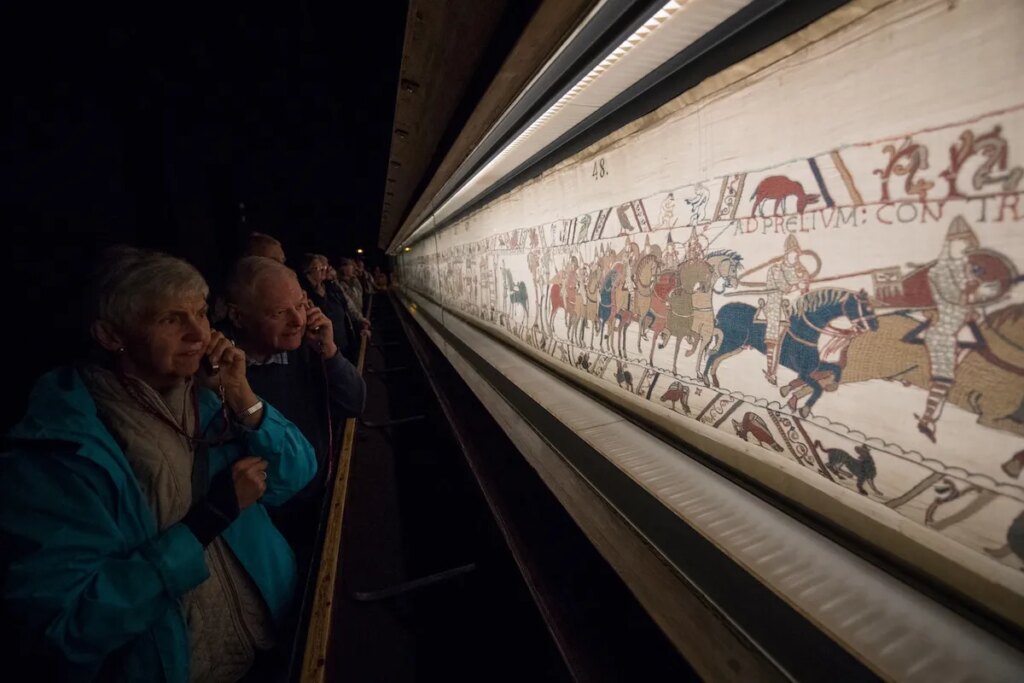
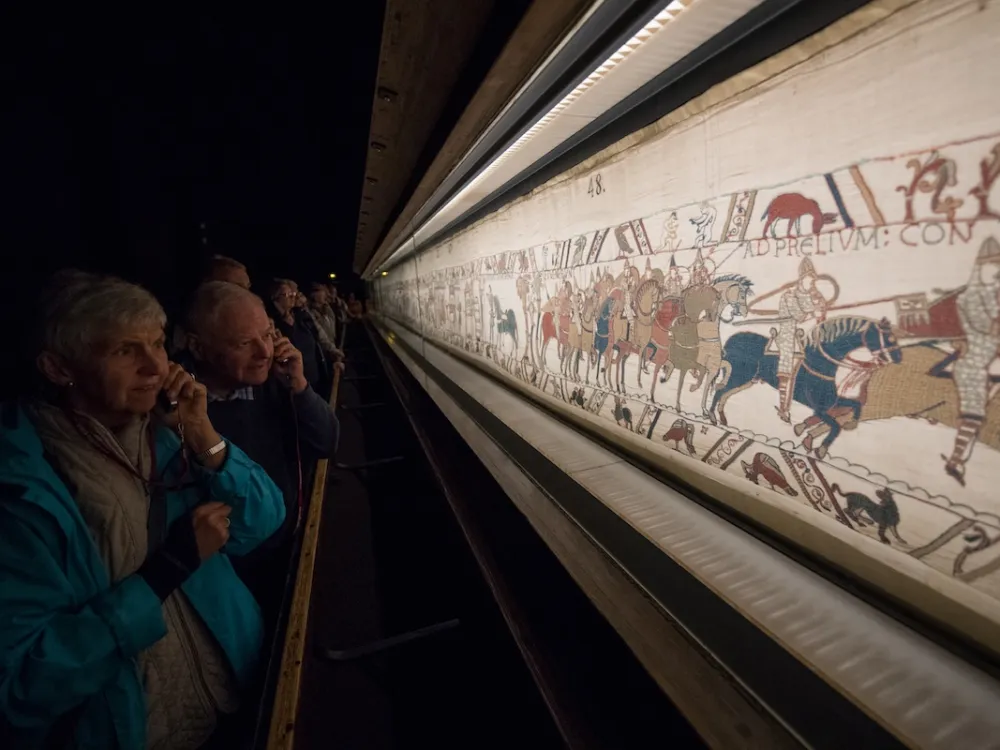
Escorted in secret by police under the cover of darkness, the millennium-old Bayeux Tapestry finally arrived to London’s British Museum on Friday. The long-awaited but controversial loan from France was welcomed at 2:48 am by a “select crowd,” including France’s ambassador to the UK, per British reports. A large black box within a gridded, aluminum casing designed to keep the relic suspended to avoid damaging vibrations was removed from a yellow truck, as some teary-eyed witnesses looked on.
\“I did well up a little bit when I saw it coming off the lorry,” said Millie Horton-Insch, curator of the museum’s Bayeux Tapestry exhibition.
Related Articles
Tens of Thousands Try for Tickets to See Bayeux Tapestry at the British Museum
UK Lawmakers Fault Government’s Oversight of National Museums, Raise Prospect of Admission Fees for Foreign Visitors
The French loan to the UK of the 70-m-long embroidery is thought to be the first time in 1,000 years that the European masterpiece has returned to England. Experts believe it was made by nuns in Canterbury to depict events leading to the Battle of Hastings and the pivotal 1066 Norman Conquest of England. The tapestry’s transfer has also been wielded as a political tool to strengthen French-British diplomatic relations, as Europe tries to unify against common foes and lessen dependence on an American ally proven fickle by the current administration.
The Bayeux tapestry loan from France “means much more than simply moving an artwork,” wrote French President Emmanuel Macron in a statement published in today’s Times of London. “Faced with the major challenges of our time — the security of our continent, technological sovereignty, innovation, energy and decarbonization, and the resilience of our democracies — we have chosen to act together,” he wrote.
The physical transfer of the embroidery took months of careful planning, as experts weighed in on how and whether it was too risky to move the highly fragile artwork, which already suffers from multiple tears and holes. Even the late artist David Hockney voiced his opinion, calling the endeavor “madness.” But, in the end, following a failed legal challenge to the project by a French heritage group, the road was cleared for the tapestry’s journey.
“For the past year, curators, restorers, engineers and teams from France, the UK and other European nations have worked with remarkable dedication and ingenuity. Together they drew up the protocols enabling the artwork to travel and be exhibited under the best possible conditions in terms of security and conservation,” added Macron. He went on to describe the transfer as “a gesture of trust, a tangible expression of a long-standing friendship and a sign of our shared desire to see France and the United Kingdom build their future together.” Earlier, he also posted a photo on social media of the British Museum’s projected slideshow on the famous white cliffs of Dover, featuring the Bayeux Tapestry and the words “merci.”
Echoing those sentiments, British Museum director Nicholas Cullinan said in a Le Monde op-ed that, “to entrust another country with one of your most cherished cultural treasures is an act that reaches beyond diplomacy. It is a gesture of confidence, of friendship and, above all, of trust.”
For the next few days, the artwork will remain in its traveling case so that it can acclimate to the new environment, according to Cullinan, speaking to the Times. Next, around 100 museum employees, selected for their similar heights, will place the tapestry into its new display case, which will present the work horizontally, at its full length. There, lucky visitors will be able to view it starting in September. Tickets for this year have sold out, but spots are still available for 2027.
The tapestry was long exhibited in Normandy’s Bayeux Museum in a horseshoe display. In return for the loan, the British Museum is loaning to France the seventh-century Sutton Hoo funerary treasures, the 12th-century Lewis Chessmen carved chess pieces, and other items.