
Though the Met Gala is held each year by the Metropolitan Museum of Art, the glitzy event is known less for its engagement with art and more for tapping the fashion industry. That changed this year, in large part because the Met Gala made a concerted effort to show off connections between fashion and art.
Taking place in tandem with the Costume Institute’s newly unveiled Met exhibition “Costume Art,” last night’s Met Gala carried the theme “Fashion Is Art,” a decidedly broad topic that allowed attendees to go in a variety of different directions. Some went far back in time, looking to ancient Greek and Roman statues. Others reached for more recent influences. The painter Amy Sherald, for example, went for one of her own paintings.
There are plenty of art-and-fashion crossovers these days, some more successful than others. That was the case at the Met Gala, too. Below, here are our thoughts on nine of last night’s art historical allusions.
-
Hunter Schafer
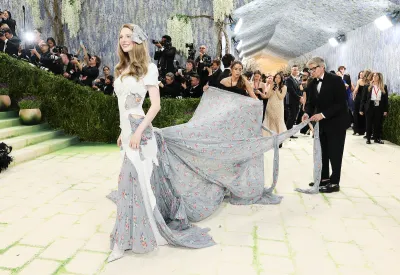
Image Credit: Mike Coppola/Getty Images What She Wore: Model and actress Hunter Schafer herself took on Seurat this week in the TV series Euphoria, in which her character painted her own take on A Sunday Afternoon on the Island of La Grande Jatte, but at the Met Gala, her reference point was a different giant of modern art history: the Austrian painter Gustav Klimt.
Schafer’s custom Prada dress was an allusion to Klimt’s 1912–13 painting Mäda Primavesi, which resides in the Met collection. The painting’s titular sitter is shown wearing a white dress by Emilie Flöge. Though the dress is adorned with flowers that highlight Primavesi’s youthful innocence, Klimt painted her with a piercing gaze that hints at wisdom beyond her years. He pitted that knowing look against her pastel-colored surroundings, which feature little images of animals such as pigs and birds.
Our Verdict: Schafer’s dress intelligently revisits Klimt’s subversive aesthetic, making her look one of the best from last night. What’s so smart about this reference is that it isn’t direct. Rather than drawing details from Klimt’s painting, her Prada dress embodies its spirit, with a front piece resembling Flöge’s garments for Primavesi that is torn away to reveal flowers underneath.
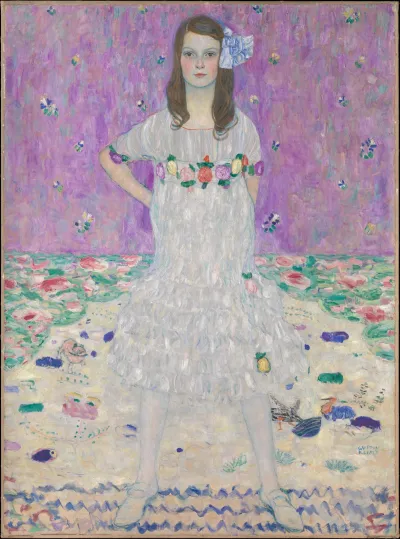
Gustav Klimt, Mäda Primavesi, 1912/13. Metropolitan Museum of Art -
Lauren Sánchez Bezos

Image Credit: Photo Angela Weiss/AFP via Getty Images What She Wore: Despite protests over her husband Jeff Bezos and Amazon’s involvement in recent ICE raids, Lauren Sánchez Bezos was on hand at the Met Gala, to which she and Bezos reportedly gave $10 million in funding. (Bezos himself skipped out on the red carpet and headed straight to the party inside.) Sánchez Bezos came dressed a black Schiaparelli ball gown that had, on one arm, a strap made of jewels. Law Roach served as her stylist.
The gown was an allusion to one worn by the socialite Virginie Amélie Avegno Gautreau in Madame X (1883–84), a painting by John Singer Sargent that’s owned by the Met. Because Gautreau’s dress was considered skimpy for its time, the painting scandalized the French art world of its day. “When you stand in front of it now, you see a beautiful woman,” Sánchez Bezos told Vogue. “For me, the image represents how fashion and cultural standards can shift over time.”
Our Verdict: Madame X may no longer be as provocative as it once was, but the painting does remain striking as ever. Sánchez Bezos’s dress, on the other hand, is boring and safe. And if you’re going to pay homage to Madame X, at least wear black! Another Met Gala attendee, the actress Claire Foy, did it better.
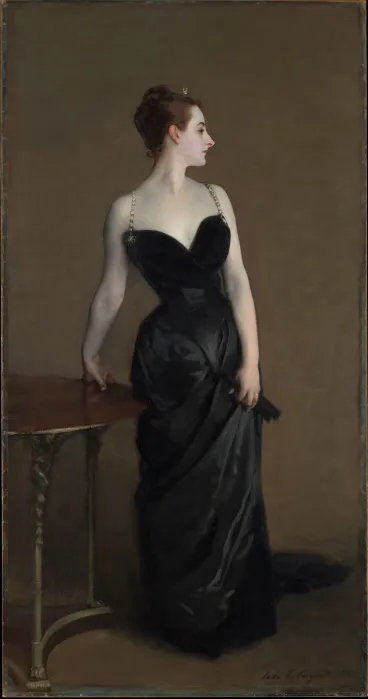
John Singer Sargent, Madame X (Virginie Amélie Avegno Gautreau), 1883–84. Metropolitan Museum of Art -
Kylie Jenner
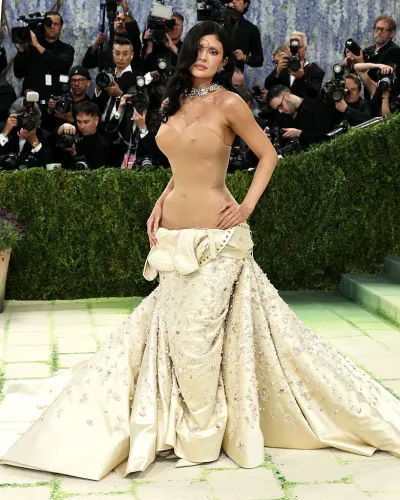
Image Credit: Photo Jamie McCarthy/Getty Images What She Wore: Kylie Jenner’s ensemble—part Schiaparelli gown, part nude illusion sculpture—was a clear tribute to the Venus de Milo, a marble sculpture of an armless figure (believed to be the Greek goddess Aphrodite) that has been part of the Louvre’s antiquities collection since 1821.
The figure twists at the waist and appears to balance on one foot; she is nude from the waist up, with carved marble fabric draped around her hips and falling to her feet. Jenner’s two-part Schiaparelli gown was made up of a skin-tone bustier that cinches up the back (complete with nipples and a bellybutton indentation, just like Venus herself) and is paired with a voluminous train. The embroidery for the train reportedly took 11,000 hours to complete.
Our Verdict: Jenner found a way to dress up as topless marble sculpture without actually being topless. And in terms of construction and logistics, her look is very impressive. But we wish Jenner—and her sister Kendall, who dressed as a different Louvre marble, The Winged Victory of Samothrace—had chosen a Greek marble from the Met’s own impressive collection. Maybe the sisters could have roped in Kim and gone as the Three Graces.
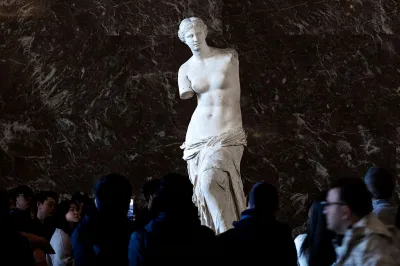
The Venus de Milo at the Louvre Museum in Paris. (Photo SEBASTIEN DUPUY/AFP via Getty Images -
Heidi Klum
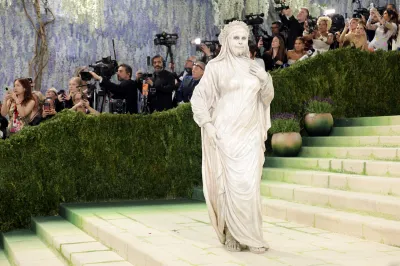
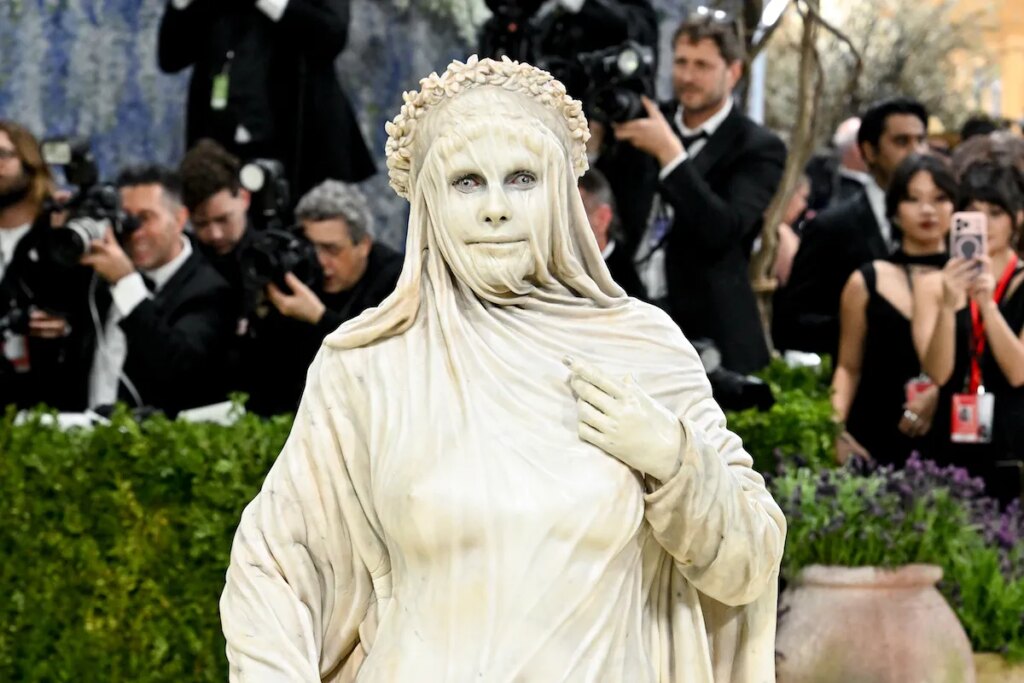
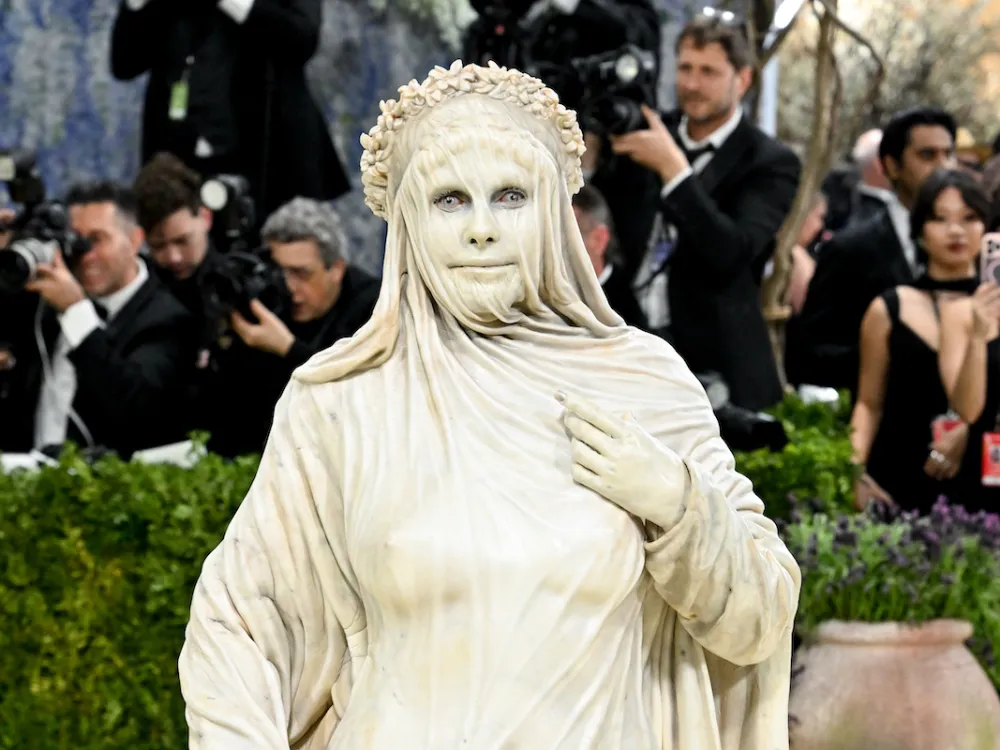
Image Credit: Photo Michael Loccisano/GA/The Hollywood Reporter via Getty Images What She Wore: Heidi Klum, a model who serves as the host of the TV series Project Runway, came garbed in a custom look by Mike Marino that resembled a sculpture. During Vogue’s livestream of the event, Klum seemed to struggle to move around as she described the four-and-a-half-hour-long process required to realize the look. “I look hard, but I’m soft,” she said.
While some, including the New York Times, identified Roman statues as Klum’s inspiration, the look was in fact a reference to Rafaello Monti’s 1847 sculpture Veiled Vestal, which, though based on ancient Roman art, is far removed from it. It features a female figure sheathed in drapery that caresses her face and body, causing Monti’s marble to appear lightweight and airy. Though Monti’s work is owned by the Chatsworth House Trust, it periodically travels; a similar work by the Italian sculptor is held by the Met, which houses it at its Cloisters annex.
Our Verdict: Well, this was certainly the most outré look of the evening—no doubt about that. But beyond simply offering plenty to gawk at, Klum’s attire perfectly nails Monti’s ability to make his heavy materials appear sheer and flimsy. And she gets extra points for her commitment to the bit.
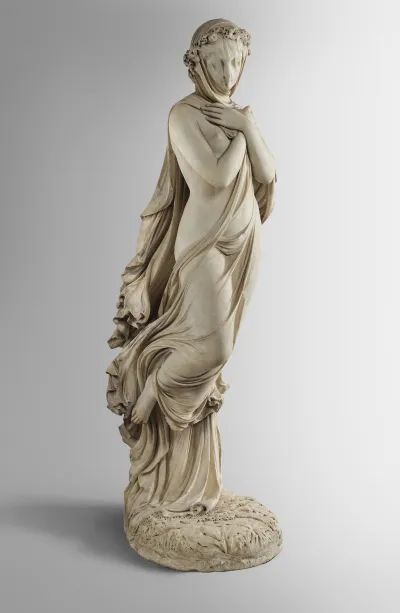
Rafaello Monti, The Veiled Woman, 1854. Metropolitan Museum of Art -
Madonna
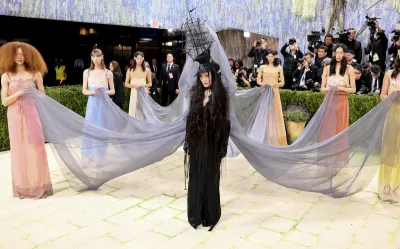
Image Credit: Photo Theo Wargo/FilmMagic What She Wore: Donning a dress designed by Anthony Vaccarello, of Saint Laurent, Madonna paid homage to Leonora Carrington, a Surrealist painter who spent much of her career in Mexico. Like many other female Surrealists, Carrington lacked mainstream recognition for years, though that began to change with shows such as Cecilia Alemani’s 2022 Venice Biennale, which placed an emphasis on women of the movement and was even named with a citation of Carrington (the title of her book The Milk of Dreams).
Madonna wore a dress that had long flows of fabric and a hat in the shape of a ship; she held a bugle in one hand. The fabric, the ship hat, and the bugle appear in Carrington’s 1945 painting The Temptation of St. Anthony, in which a giant figure in white robes and a sleeping pig sit beside a river of water that pours out of a jug. As is common in Carrington’s work, the painting hints at bizarre rituals while also remaining set within the real world: St. Anthony, for one, actually lived in 13th-century Italy. The painting is currently on view in a Paris survey of Carrington’s art at the Musée du Luxembourg.
Our Verdict: Unlike many of the works referenced at the Met Gala, The Temptation of St. Anthony is not especially famous. That alone makes it notable in an event where many of the allusions felt simple, even a little basic. But we think Madonna also perfectly nailed the witchy spirit of Carrington’s art, retaining her air of mystery while also tastefully contending with the work itself.
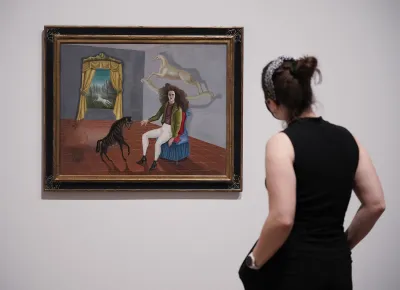
A person looking at self-portrait by Leonora Carrington. Photo Yui Mok/PA Images via Getty Images -
Rosé

Image Credit: Photo Jamie McCarthy/Getty Images What She Wore: Rosé, the lead singer of the Korean girl group BLACKPINK (and one of the stars of the most recent season of The White Lotus), showed up to the Met Gala in an understated strapless black gown by Saint Laurent, styled by self-described “image architect” Law Roach. Rosé considers Saint Laurent creative director Anthony Vaccarello her best friend and favorite designer; Vaccarello also happened to be one of the co-chairs of this year’s Gala.
Roach and Rosé were intrigued by the fashion house’s ongoing fascination with a bird-in-flight motif inspired by the French artist Georges Braque’s stylized depictions of birds throughout his career. One of Braque’s most well-known pair of birds appears on the ceiling of the Henry II room in the Louvre: Two black birds outlined in white fly towards each other on a deep blue background, surrounded by decorative ceiling panels. For the Gala, Rosé placed the large, shimmery bird-shaped brooch near her left hip, just above gown’s thigh-high slit.
Our Verdict: Rosé gets points for the subtlety of her callback, and for connecting her chosen art historical reference point to Saint Laurent’s own history. The diamond Tiffany & Co. necklace pointing to the bird brooch was also a nice touch.
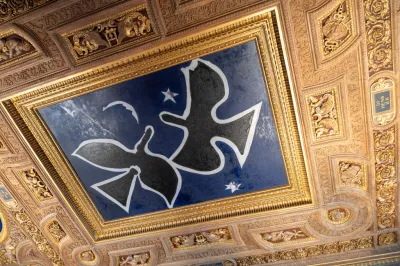
Georges Braque’s painting The Birds, 1952-53 on the ceiling of The Louvre n Paris. Photo Antoine Boreau/Hans Lucas/AFP via Getty Images -
Ben Platt
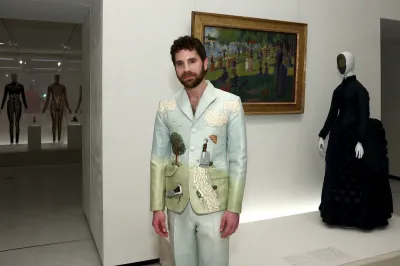
Image Credit: Stephanie Augello/MG26/Getty Images for The Met Museum/Vogue What He Wore: Ben Platt came to the Met Gala wearing a custom suit by Tanner Fletcher, who said on Instagram that the outfit was the result of 120 hours of labor. The silk wool suit was painted by hand and embroidered, and included beads strung into its surface.
The suit features a woman with parasol lifted straight from Georges Seurat’s A Sunday on La Grande Jatte—1884, which also featured in Hunter Schafer’s look for the evening. Seurat’s painting is considered an iconic work of the Pointillist style, wherein tiny dots or dabs of color cohere to form landscapes and pictures of people when seen from far away. Though Seurat’s painting includes plenty of other characters, including children at play and adults strolling around, Platt’s suit isolates just the woman with the parasol and a reclining man.
Our Verdict: Seurat’s sense of composition is one reason museum visitors love to stand before his painting for long periods of time. Few are likely to do the same for Platt’s suit, which through its childish look shears away Seurat’s refinement. (Depriving Seurat of his dots? Really?) And yes, it is true that the Met owns a study for A Sunday on La Grande Jatte and has even included it in “Costume Art,” but we feel compelled to note that the most famous version of this painting is housed instead at the Art Institute of Chicago, making the reference a weird choice.
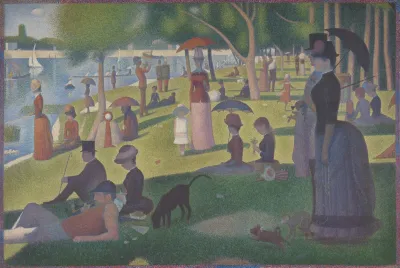
Georges Seurat, A Sunday on La Grande Jatte — 1884, 1884–86. Art Institute of Chicago -
Troye Sivan
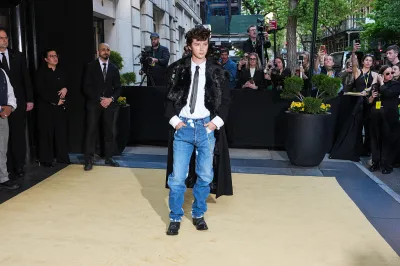
Image Credit: Photo John Nacion/Getty Images What He Wore: In 2021, the lithe Australian singer Troye Sivan dipped his toe into the art of art historical references at the Met Gala, at the time explaining that he was inspired by New York, which to him meant black and white, leather, and Robert Mapplethorpe. That year Sivan showed up in a black slip dress, Cartier jewels, platform heels, and a leather bicep strap. Five years later, Sivan took his Mapplethorpe homage all the way, from the floppy, tousled hair to the skinny black tie to the bleach-stained jeans (yes, jeans, at the Met Gala) to the long, loose coat.
Mapplethorpe was known for his black-and-white portraits—of his friends, fellow artists, celebrities, and himself—as well as racier fare shot at BDSM clubs and still lifes of flowers. His career ended early, when he died of AIDS-related causes in 1989. “I thought so much about the artists that we lost to AIDS, and what a time that must have been to be in this city and to be an artist in this city, and how impactful the work was and forever will be,” Sivan said of the lost generation of queer artists he continues to draw inspiration from.
Our Verdict: This look is so faithful, it’s almost like a paparazzi shot from a biopic starring Sivan as Mapplethorpe. (Albeit a biopic with a sky-high wardrobe budget.) Sivan’s adulation of 1970s and ‘80s queer New York is genuine, but this one is a little on the nose. Also, it’s jarring to see jeans at the Met Gala—even if they are Prada.
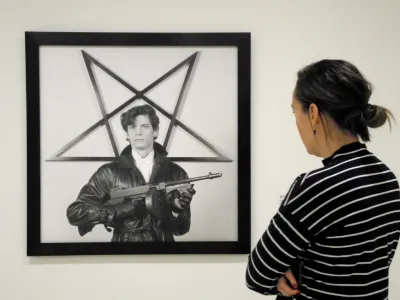
A visitor admiring at a self-portrait of Robert Mapplethorpe in the exhibition “Implicit Tensions: Mapplethorpe Now” at the Guggenheim Museum, New York, 2020. Photo Johannes Schmitt-Tegge/picture alliance via Getty Images -
Naomi Watts
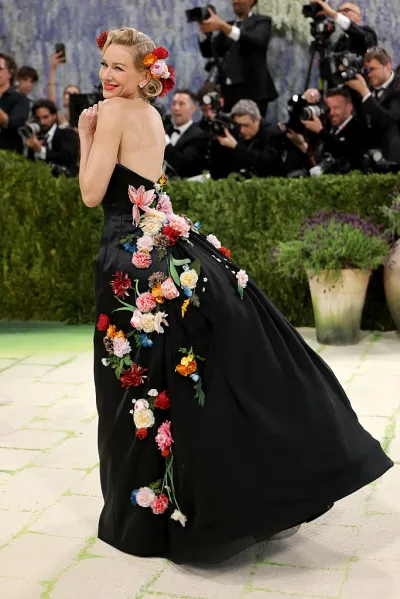
Image Credit: Photo by Mike Coppola/Getty Images What She Wore: Naomi Watt’s Met Gala look involved flowers—lots and lots of colorful flowers. They were appliquéd to her strapless floor-length Dior gown, glued onto her faux fingernails (which took five hours to design and apply, according to her manicurist), and tucked into her elegant coif.
Dior creative director Jonathan Anderson is known for his collaborations with artists (especially when he was at Loewe), and for Watts’s gown he drew inspiration from a Dutch Golden Age still life on view at the Met: Margareta Haverman’s A Vase of Flowers. It is one of only two works by Haverman that survives today; the other, also a floral still life, is at the National Gallery of Denmark.
Our Verdict: The Haverman nod is a real IYKYK moment for art history nerds who may have spent time admiring the Met’s collection of late 17th and early 18th century Dutch still lifes. You’d expect nothing less, given Anderson’s history of collaborating with artists, both contemporary and otherwise.
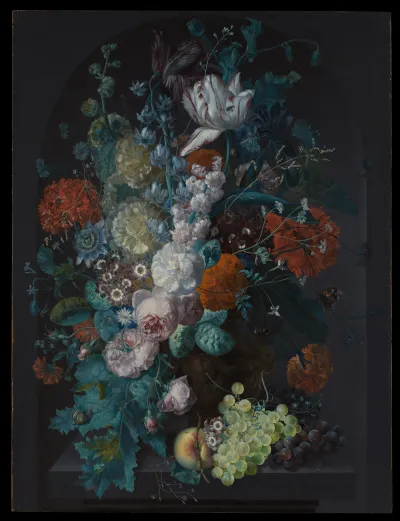
Margareta Haverman: A Vase of Flowers, 1716. Courtesy Metropolitan Museum of Art, New York -
Angela Bassett
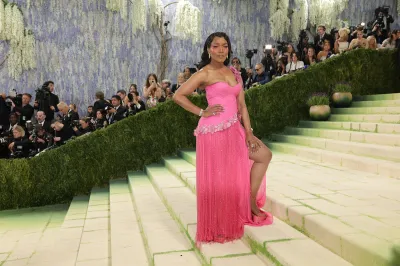
Image Credit: Photo Michael Loccisano/The Hollywood Reporter via Getty Images What She Wore: Where most of the Met Gala attendees went for canonized artists, actress Angela Bassett instead drew her inspiration from a lesser-known Harlem Renaissance painter. Wearing a dress by Prabal Gurung and shoes by Alevi Milano, Bassett paid homage to Laura Wheeler Waring’s ca. 1927 painting Girl with Pink Dress, a work that’s owned by the Met, which previously displayed it in its 2024 survey of the Harlem Renaissance.
Waring was known for her paintings of Black women, some of which she made on commission from the Harmon Foundation, one of the first organizations to support Black American modernists. Working in a realist mode, she often paid close attention to the Jazz Age fashion worn by her sitters. Bassett’s dress is not identical to what’s shown in Waring’s painting—it features a tasseled bottom that can’t be found on the girl’s garments—but its beaded strap is similar to the one Waring depicted.
Our Verdict: Bassett’s dress performs double duty: It both upholds the work of an under-recognized artist and successfully captures the elegance of the artwork that influenced it. We approve. Extra props for Bassett’s matching pink makeup.
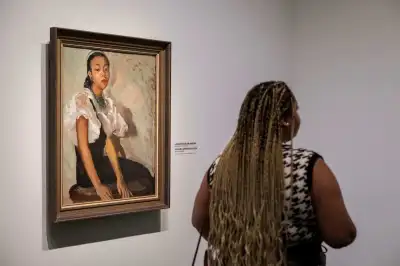
A painting by Laura Wheeler Waring in the Met’s Harlem Renaissance exhibition from 2024. Photo Angela Weiss/AFP via Getty Images