
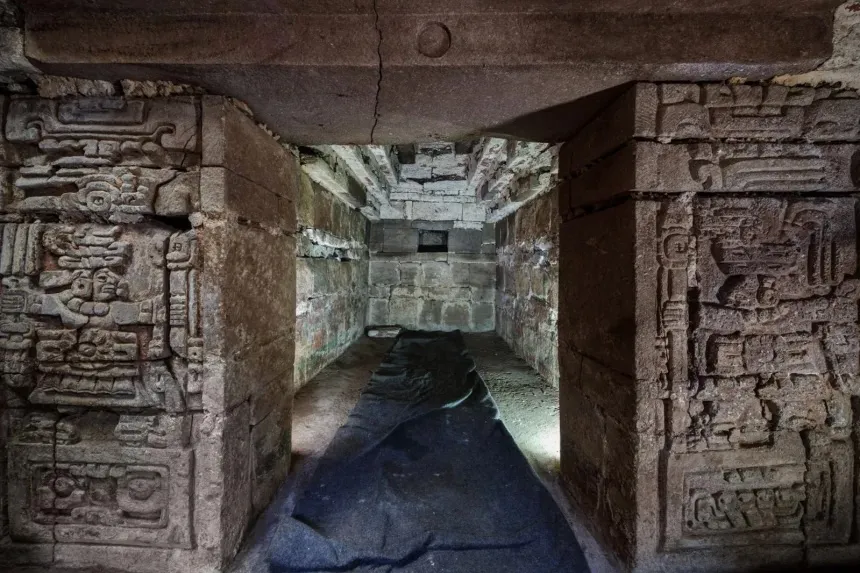
Archaeologists in southern Mexico have unearthed a 1,400-year-old Zapotec tomb bearing intricate carvings, a discovery hailed by experts as “the most significant” of the last decade.
The tomb was discovered in San Pablo Huitzo, Oaxaca, and dates to around the year 600 CE, according to a statement released last week by Mexico’s National Institute of Anthropology and History (INAH).
Experts have noted the exceptional preservation of the burial chamber’s features, including a sculpture of an owl perched at its entrance. A sculpture of a man’s head is visible inside the owl’s beak, thought to represent the individual interred within the tomb, the INAH said. The Zapotec language is still spoken by hundreds of thousands people in Mexico, where the owl, in Zapotec culture, symbolizes night and day.
Related Articles

Palestinians Decry Israel’s Plan to Seize West Bank Archaeological Site: ‘A Violation of Our History’
Humans, not Glaciers, Moved Rocks Used in Stonehenge’s Construction, According to New Evidence
Multicolored murals depicting symbols of authority and death were found at the tomb’s threshold, alongside carvings of two human figures holding artifacts, who may have served as guardians of the tomb, according to INAH. Inside the burial chamber, an “extraordinary” mural rendered in ocher, white, green, red, and blue depicts a procession of figures carrying bags of copal, a tree resin burned as incense in ceremonial rites.
“It’s the most significant archaeological discovery of the last decade in Mexico due to the level of preservation and the information it provides,” Mexican President Claudia Sheinbaum told reporters at a news conference.
Mexico’s culture secretary, Claudia Curiel de Icaza, reiterated that the site is an “exceptional discovery,” citing what it reveals about ancient Zapotec social organization, funerary rituals, and belief systems that are preserved in its architecture and the murals.
A team from the INAH is now carrying out preservation work and ongoing research at the site.