
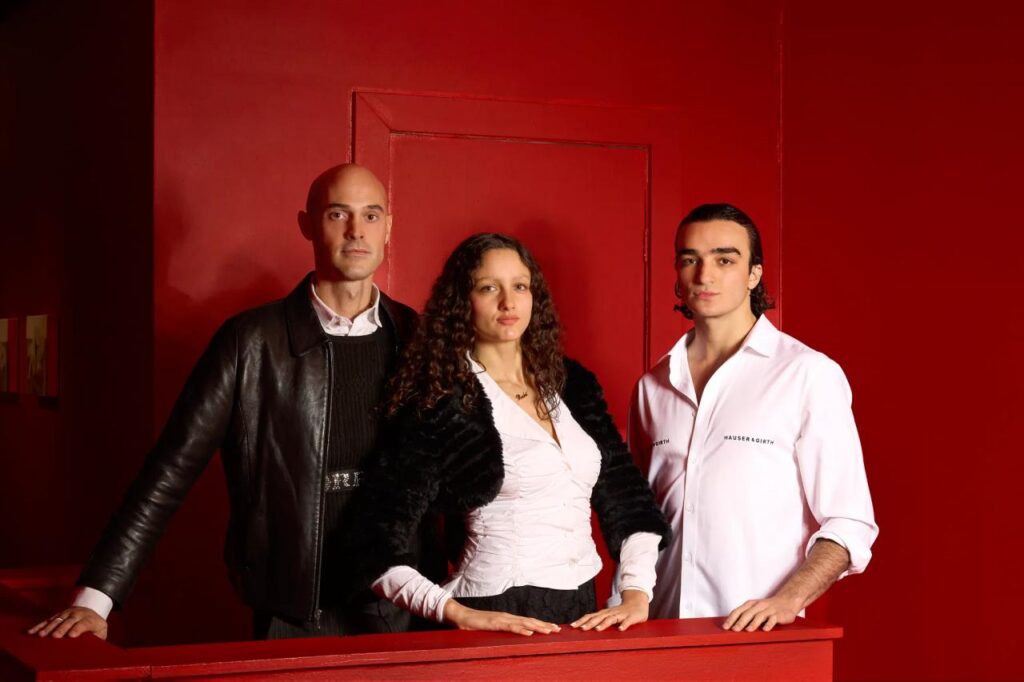
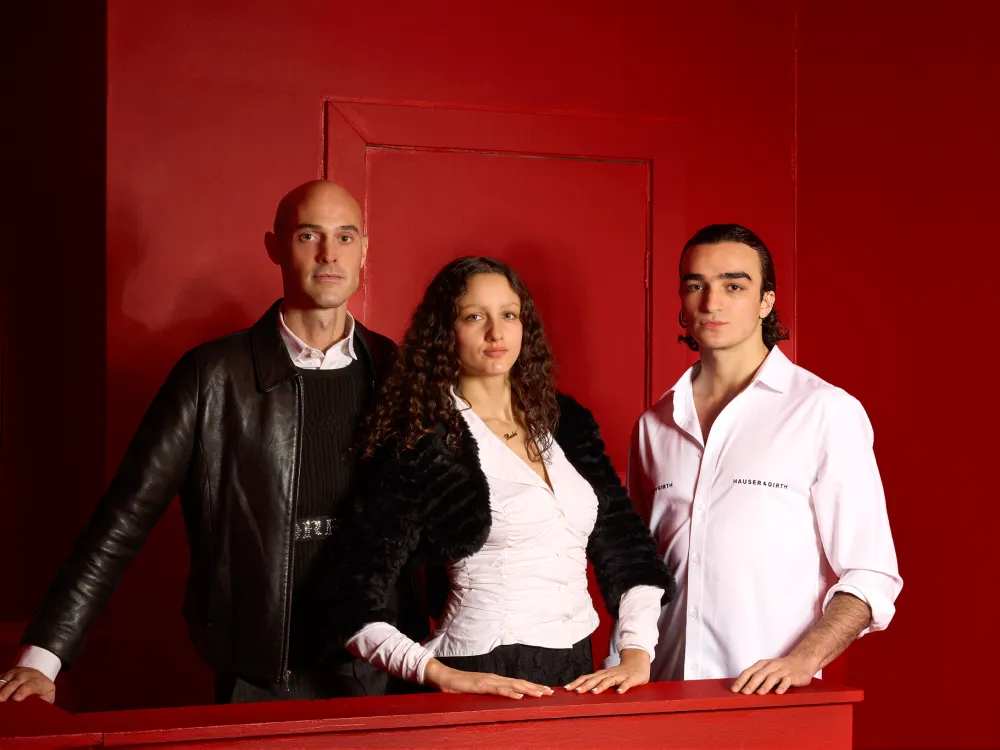
A cold wind cuts through lower Manhattan, passing shuttered storefronts that once housed small galleries—some casualties of the rent crisis—before losing force at the corner of Broome and Chrystie Streets. There, a different kind of market experiment took shape. Last year, Spielzeug Gallery, a nomadic curatorial project had a turn as a brick-and-mortar commercial gallery, testing a model that reads almost anachronistic beside Tribeca: one in which chaos is not a pose, but the consequence of combining pleasure and survival within the same space. The purpose, after all, is embedded in the name itself. The gallery’s nameis the German word for “toy.”
Related Articles

Belgrade Trump Hotel Project Dropped After Serbia’s Culture Minister Is Indicted
Gagosian, David Zwirner, Pace, and Dozens More Galleries Join Anti-ICE National Strike
“Toys always come with an idea of control,” said Evan Karas, the director and founder of Spielzeug. “Toys are about working with your hands—pulling a Barbie apart. As children, we rely on objects to make sense of reality. That intensity never really goes away in adulthood; it just shifts into something psychosexual.”
The first exhibition Karas staged in the Chrystie Street space, aptly titled “TOYS! TOYS! TOYS!” was a veritable thesis on that idea. It felt less like a showroom than a dimensional rift: chimeric objects and kinetic installations slumped against, or sprouted from, the crimson walls, while one massive, mutated jester by Thomas Liu Le Lann sprawled on the floor, daring the dense, intergenerational opening-night crowd—friends, family, and variable NYC nightcrawlers alike—to dodge, duck, or simply recoil.
Spielzeug landed at 131 Christie Street through a collaboration with 1 Day at a Time, a nimble enterprise that offers nomadic creatives the practical services to secure a foothold in New York City—less a guarantor of success than a way of offering what the rent crisis has rendered nearly impossible: room to grow. Jordan Harper White, one of the organization’s founders, described its behind-the-scenes work as “manufacturing legitimacy,” a way of answering the brutally simple question of investment: Is this gallery going to be here tomorrow?
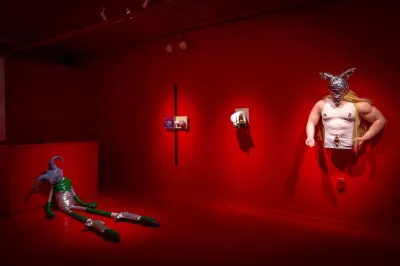
At the gallery, nothing appeared overly protected from failure. From a wall, the top half of a silicon figure—part man, part creature—emerged, bearing long, blonde hair and a chrome deer head. Titled Nipples Are the Windows to the Soul (2025) and created by Josh Rabineau, it invited visitors to peer through peepholes on its chest. From across the room, a little ceramic traffic cop by Michelle Im faced the lewd portals, “a simulated soul trapped inside a hallmark of authoritarian subservience,” as Karas described it, shuddering. “Terrifying.”
Karas, 25, grew up in Chicago before landing in New York in the summer of 2021. Art entered his orbit almost incidentally: a brief internship at Marc Straus Gallery ended with an encounter with Hungarian painter Diki Luckerson, which sparked the vision for Spielzeug. Yet it was the years before art—hopping between hospitality and interior design gigs—that developed a sensitivity to the interplay of vibe, object, and container. That sensibility guides Spielzeug’s curatorial model, self-described as an “itinerant fantasy”: venues have included a remote Czech bunker, a party bus, and a Bushwick apartment (which hosted Diki Luckerson’s “Lychee from a Poisonous Tree,” a show of smeary, semi-abstract paintings in which bodies bubble and bleed in a prism of color and desire.) There’s letting loose, Karas said, and then there’s something rarer: total surrender.
“It’s objects that make me feel less alone in my body,” Karas said. Pairing them with the right place, he added, “there’s a sense of cleaving open a complete imaginative realm—a beautiful escapism in which people feel re-embodied in the hyper-physicality of everything.”
Spielzeug’s ethos feels fragile in 2026, but it slots naturally into a lineage of New York alternative exhibition spaces. From the loose coalition of artists who converted 112 Greene Street in Soho into ad hoc venues in the 1970s, to a more pointed comparison in Colin de Land’s American Fine Arts, Co., experimentation tends to flourish in deliberately unstable conditions. De Land ran AFA as an alchemic hybrid—part salon, part gallery, part archive, part intellectual provocation—operating across marginal spaces to resist the fixity of a supermarket-for-art.
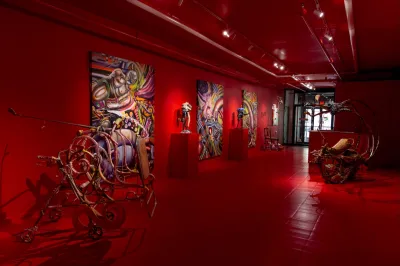
What’s changed isn’t the impulse, but the terrain. Today, Karas has peers—he cites Alyssa Davis Gallery among a crop of personality-driven, conceptually nimble spaces—but the room to linger or improvise is, by some accounts, narrowing. Hyperallergic estimated that New York has lost roughly 60 small venues over the last three years, including Clearing, JTT, Queer Thoughts, and the nonprofit Canal Projects.
It’s within that churn that 1 Day at a Time operates, according to Harper White and Isabelle Rose Basha, his professional collaborator and partner. He’s a trained graphic designer; she’s a performance artist. Together, they combine logistical fluency with an intuitive sense of how artists actually gather and sustain one another.
“The idea is to share resources with curators and artists, not gatekeeping or putting our egos first,” Basha said. “The more we can break down those walls, the more everyone in the art world is empowered.”
Today’s organization grew out of a Covid-era digital art advisory that produced 3D walkthroughs of gallery and museum exhibitions—painstakingly rendering the ephemeral and material qualities of art at a moment when physical access vanished. Nearly six years later, it’s hard to imagine, but this was the advent of virtual walkthroughs, and Harper White played a role in making it what it is today: an industry expectation. (“TOYS! TOYS! TOYS!”, for example, can be explored virtually here.) His early clients included the Brant Foundation, the Shed, and, later, Art Basel Miami Beach.
But his and Basha’s professional focus ultimately shifted, as participation in New Inc, the New Museum’s mentorship program for digital experimentalists, opened the door to artist management: at one point, they were advising roughly 40 artists simultaneously. Today, 1 Day at a Time runs a residency and exhibition program that guides inherently porous practices toward professionalization. Spielzeug has always had an eye for talent—Sophie Jung’s Wahrzeichen (2023), shown at Basel Social Club, was acquired by the Kunstmuseum Basel—but even a stint running a brick-and-mortar shop, opposed to a purely roving program, proved an enlightening learning curve.
“It’s negotiating a paradox,” Harper White said. “Teaching the frameworks of the business to out-of-the-box projects, so they can reach a certain level of market appreciation.” Beyond their commercial utility, Harper White added, virtual walkthroughs also serve as tools of access—opening exhibitions to visitors who may never pass through the door—and as instruments of reflection. For curators like Karas, newly responsible for the room, revisiting decisions after the party’s ended becomes a reality.
And with it comes a familiar New York contradiction: can a provisional practice be granted more time in this world without losing the spontaneity that made it noteworthy? It’s a game Spielzeug will play, come what may.