
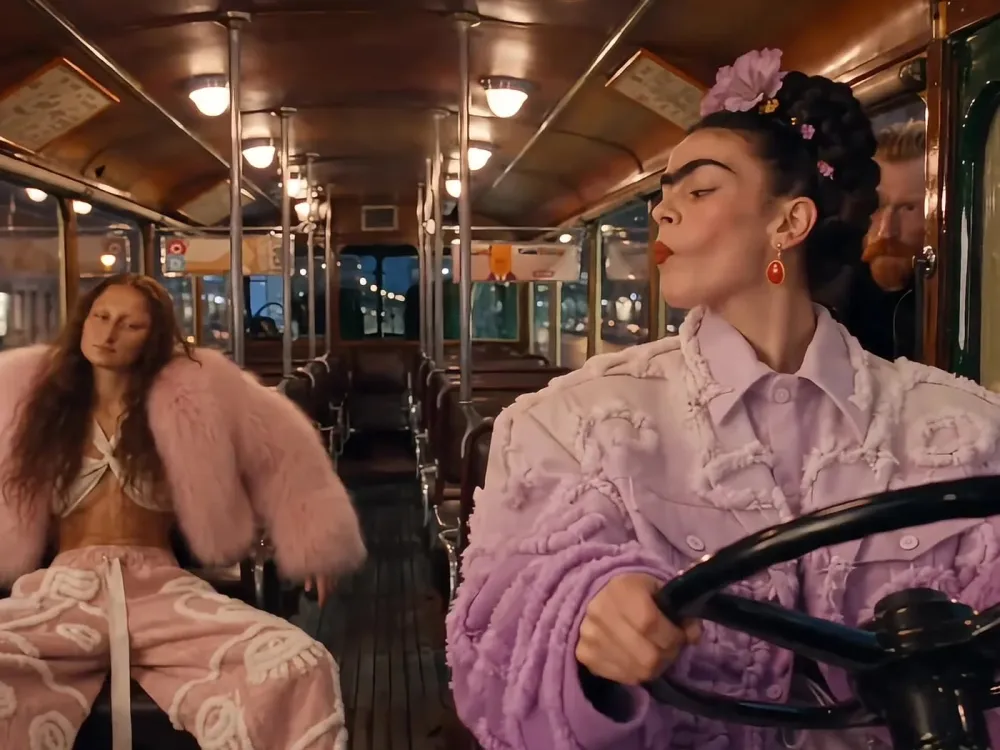
In our Frida Kahlo–obsessed moment, it’s may be difficult for some to remember that the Mexican artist almost died before she could change art history. In 1925, when she was just 18 years old, she was riding a bus that collided with a trolley, an accident that severely injured her pelvis, abdomen, and uterus. During the painful recovery, she took up painting. “I am not sick,” she said. “I am broken. But, I am happy to be alive as long as I can paint.”
A little over a century after the accident, the fashion brand Les Énervés, which has its roots in Paris and Bali, released an ad campaign that seemed determined to posthumously break Kahlo all over again, this time using AI.
Related Articles
Fundación Kahlo Launches $50,000 Prize for Emerging Mexican Artists
Mexican Government Faces Legal Action over Its Handling of Art Collection Rich in Kahlos
In the bizarre ad, which was first posted to Instagram in October and started going viral on X this month, a bubblegum-chewing Kahlo recklessly drives a bus through Paris. Her passengers include the Mona Lisa and Vincent van Gogh, his severed ear replaced with a steel prosthetic. It’s worth noting that the Kahlo depicted here downs multiple drinks before getting behind the wheel; the real artist struggled with alcohol and drug addiction.
“It’s Frida, bitch,” she says, just before the soundtrack switches from an Édith Piaf song to Britney Spears’s “Gimme More.”
According to a release by Les Énervés, the ad was directed by the brand’s founder, Wakim Krari, and was produced using what is described as “AI, and a lot of patience.” The brand’s website adds that AI has been used to recreate Kahlo’s bus, this time as a Renault TN, which might have been seen in Paris when Kahlo staged an exhibition there in 1939.
Les Énervés has attempted to frame the ad as some sort of statement of reclamation. “A hundred years later, she is the one driving,” Les Énervés notes. “Vincent and Mona Lisa are in the back. Nothing is going to hit her this time.”
Not everyone has the same interpretation. One X post with 46,000 likes says the ad is “disrespecting the dead.” I concur.
View this post on Instagram
Worse, it’s far from the first generated AI-generated Kahlo project to disrespect her memory. Another AI-generated video, also making the rounds on TikTok and X, finds Kahlo recast as a Spice Girl, singing “Wannabe” alongside the Mona Lisa, Vermeer’s model from Girl with a Pearl Earring, and the woman from Jan van Eyck’s Arnolfini Wedding. There are also quite a few Kahlo chatbots online, including one that implores viewers with this prompt: “Ask me about my struggles with physical pain, my relationship with Diego Rivera, or my feminist beliefs.”
It’s one thing to feed the Mona Lisa into AI, and quite another to use AI to mess with Kahlo, who carefully fashioned her own self-image in ways that resisted the social norms expected to guide a 20th-century Mexican woman. In her painted self-portraits, she consciously sported a darkened unibrow and facial hair men’s clothing, flouting gender expectations. She was famous, too, for wearing Tehuana skirts, positioning Indigenous Zapotec culture as central to Mexican identity. (Her unibrow also figures in the Les Énervés ad, here because Kahlo draws it onto the Mona Lisa, who has little to no eyebrows. “The woman who has too much of it gives some to the woman who has none,” the brand informs viewers.)
The nuances of her fashion are increasingly sandblasted by brands ranging from Barbie dolls to tequila bottles. Mari Carmen Ramírez, the curator of a show called “Frida: The Making of an Icon” that is now on view at Tate Modern in London, has said that Kahlo’s image has become “subsumed” by artists and activists, seemingly both for the better and the worse.
To me, all this AI-generated Kahlo content is subsuming the artist by another means. The reason to be concerned about all this, though, is only partly to do with the commercialization of Kahlo—it’s more about AI and the ways it can be used to distort, and perhaps even disregard, art history.
It might seem cute, for example, to place Kahlo at the center stage of art history, in such a way that sidelines her husband, the artist Diego Rivera, who features in the Énervés ad as trying to keep up with Kahlo while she walks down a rain-slicked street.But their 25-year relationship was more complicated than that: Kahlo was both deeply in love with and frequently frustrated by Rivera, who betrayed her by having an affair with her younger sister. The gesture here is a simple-minded one, easily made given that Kahlo is alive to comment. (She died at 47 in 1954, when she was nowhere near as famous as she is today.)
One is tempted to invoke Britney Spears, just as Les Énervés has done, and say to this brand: Leave Frida alone. Perhaps Les Énervés will do just that, but the brand has seemingly already found its next target. “The next chapter is coming soon, with a new muse and new things hidden in the frame,” the brand promises on its website. It reads like a threat.
Read More About:
- Frida Kahlo