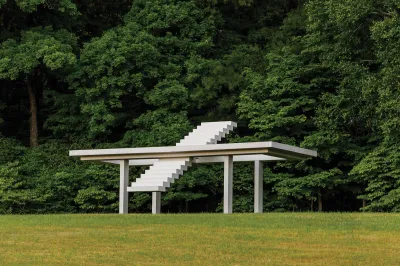
On Jill and Peter Kraus’s almost 400-acre property in Dutchess County, New York, the rolling hills add to the serenity and also create drama. Standing in front of any one of the 18 commissioned outdoor sculptures here, you can’t see any of the others. Sabine Hornig’s 2010 concrete work, Entrance With Floating Stairs II, for example, stands atop a hill. “What I love about this piece is the siting of it,” Jill Kraus told me as we pulled up to the work on a Polaris utility terrain vehicle this past May. “You come across it, and as you drive toward it, it starts to disappear—and then it comes back. I think this is the most perfectly sited piece we have. Everybody thinks we manipulated the landscape here—we did not.”
Related Articles
A New Hudson Valley Art Space Promises to Be As Accessible as It Is In Flux
Leah Ke Yi Zheng Joins Antenna Space, Pérez Art Museum Miami to Honor Nicolas Berggruen, and More: Industry Moves for October 28, 2026
For the past two decades, the Krauses have worked with artists to conceive of site-specific artworks for the expansive property. “Most people who collect outdoor sculpture just buy and plop it—they have ‘plop art,’” Jill said. “People are surprised when they come here because they think that’s what we’ve done. They’re always shocked at how we work.”
To see all of the outdoor commissions, from a Roxy Paine tree to a set of colorful abstract sculptures by Franz West, plus the Art Barn, which is like a mini museum, requires about six hours, with at least two of those having to be well past dusk to accommodate three video projection pieces. The works differ greatly in scale, materials, and approach, but the connective tissue between them all, Jill said, is “they’re all dealing with this place.”
The tour typically begins with Sol LeWitt’s Dome Structure (Four Domes and A Sphere), his only spherical work ever realized. The concrete sculpture, which stands atop a 10-foot foundation so it doesn’t slide down the hill, holds a tender spot for the Krauses, whose children were friends with LeWitt’s children at boarding school; the couple asked the artist to make them a work before his death in 2007. In the two decades since, the piece has weathered the elements, though not without fissures.
When commissioning an artist to make a new work, Jill opts for a collaborative approach, which she attributed to having gone to art school for both her BFA and MFA, and working as a design director for 20 years. “I like to discuss ideas and push artists out of their comfort zone to get them to think about things that they might not normally think about,” she said. “We want them to look at the natural habitat and then react to it.” The couple doesn’t work with an adviser, and instead sources any engineers or fabricators needed to realize a project themselves. “It’s all about talking things through. We work through ideas, and I think that’s what makes what we’re doing very different from what most other collectors do.”
Their one requirement is that an artist visit at least twice, “once when the leaves are on the trees, and once when the leaves are off the trees,” Jill said. “Then we say to them, ‘You can drive all over the property. We’ll show you every square inch, and you find a spot where you want to work.’”
One of the Krauses’ most collaborative pieces is Between sky and earth by Tatiana Trouvé, which was first commissioned in 2012 and has been adjusted at least yearly ever since. “I warned them that it was going to take time, and that this slowness was part of my work,” Trouvé told me. “They said, ‘We have all the time in the world!’”
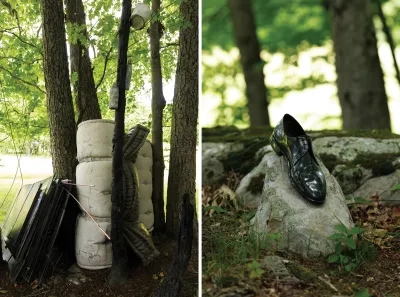
The work imagines the Guardian, a hermit who lives atop a wooded mound about 65 feet in diameter, situated in a clearing on the property. He’s not in at the moment, but you can peruse his belongings—books, chairs, a patent leather shoe, suitcases, blankets, a rolled-up cot, paint cans, a collection of ropes—all fabricated in concrete, copper, or bronze. The work is in a constant state of flux, in dialogue with its natural environs and the seasons. “We’re trying to decide, how much do we let nature take over the piece?” Jill said, noting that moss has begun to grow over parts of it, while some elements have had to be moved after proving too heavy for the branches they once hung from. “It’s not an object,” Jill added. “It’s a world.”
“Jill and Peter have that touch of madness that belongs only to passionate people driven by their deep love for artworks and artists,” Trouvé said. “Alongside art and artists, they live an adventure built on sincerity, audacity, and determination.”
The Krauses started collecting art in 1980, their first purchase being a print by Pierre Alechinsky, a birthday present for Jill, shortly after they married. Works on paper would be their focus for the next several years because that was all they could afford at the time. “What we really liked was sculpture, but that’s hard to collect when you live in a New York City apartment,” Jill said. They put off buying a summer home for a few decades until finally they decided that if they bought a substantial piece of land, they could commission artists to make site-responsive sculptures there. They began searching within a two-hour radius of Manhattan, at first thinking that Connecticut might be right.
“What we didn’t realize is that the difference in the geography from Connecticut to New York is huge,” she said. “A glacier came down the Hudson River Valley and took the tops off the mountains, so everything is rolling hills on the New York side. The Connecticut side is very tight, peak to valley, so there are no big, expansive views. The difference visually is huge.” In 2001, their broker recommended they see a piece of land that wasn’t on the market, with rolling hills where the previous owner, actor James Cagney, grazed his long-horned cattle. “We came to look at it, and we said, ‘Absolutely, this is it,’” Jill recalled.
The Krauses are unlike their neighbors, many of whom own this much land so they can ride horses or hunt. After buying the property, when asked if they were interested in either of those, Jill replied with a twist on agriculture: “No, we’re growing art.” Their modestly scaled modernist house, nestled in a secluded spot, is also an anomaly up here: They were able to persuade the Dutchess Land Conservancy that such a structure had “historical precedent”—a requirement of their purchase agreement—because Harvard Five architects John M. Johansen and Marcel Breuer both had connections to the area.
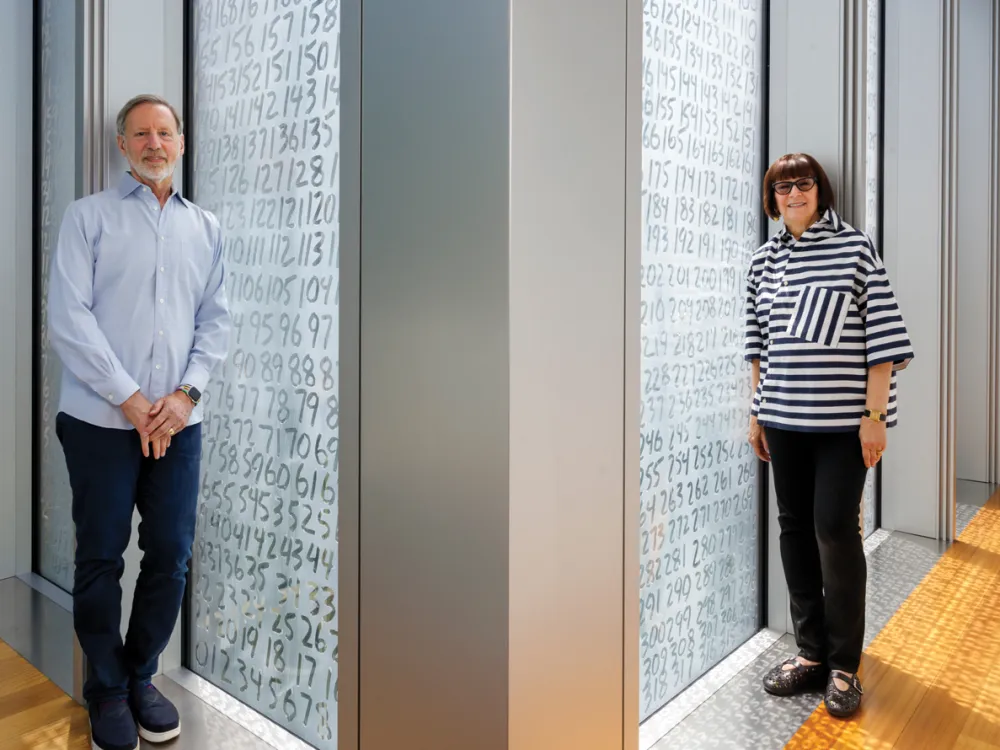
The brightly colored walls in the home are filled with the Krauses’ collection, including works by Tacita Dean, Raymond Saunders, Rachel Harrison, Richard Tuttle, Rudolf Stingel, and Franz Ackermann, the latter a commission. Upstairs is To Count: Intransitive (1972/2009), a site-specific piece by Mel Bochner, who inscribed 10 windows with hundreds of numbers, starting with 0, in different arrangements. In the late afternoon, the setting sun sends their shadows onto the floor and walls.
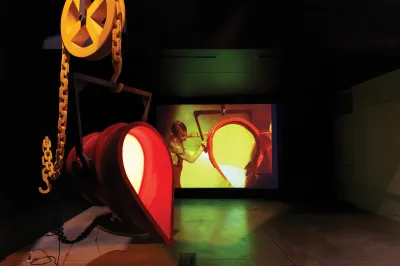
On the other side of the property is the Art Barn, which holds a rotating display of artworks. When I visited, there were pieces by Meriem Bennani, Alvaro Barrington, Lauren Halsey, and Helen Marten on view. In one corner was Ericka Beckman’s mesmerizing video Cinderella (1986), with an original set piece installed nearby; around another corner was Alex Da Corte’s video Rubber Pencil Devil (2018), which they saw when it debuted at the Carnegie International that year. “When it was time to install it, I said, ‘I can’t put this in a white box—it won’t work,’” Jill recalled. Peter suggested calling the artist for his thoughts, to which Jill replied, “I’d rather ask for forgiveness than for permission.” She painted the walls yellow to match the playful spirit of the work and added her colorful dining chairs.
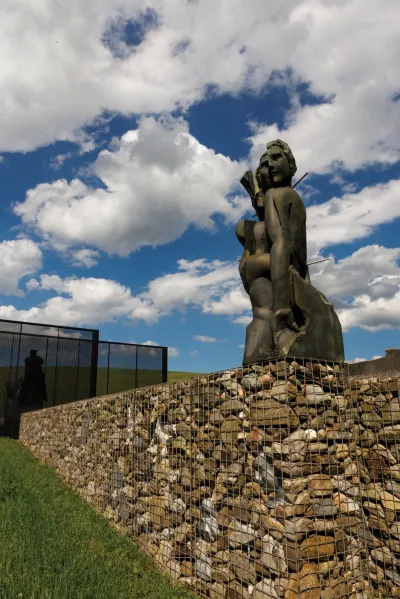
If there is one thing that characterizes the Krauses’ approach to collecting, it is the sheer investment of time. Due to a tricky structural issue, their home took eight years to complete; but that’s nothing compared to the outdoor sculptures. Matthew Monahan’s Second Nature (2023) took around 14 years, though the first eight or so of those involved the Krauses trying to convince the artist to take on the commission. It’s not unusual for that stage to take some time; for example, at the moment, they are in the ideation process with Max Hooper Schneider and Meriem Bennani. “Jill and Peter are aware of the conventional solutions that artists use to get the job done,” Monahan told me by email, “and I suspect they work to positively sabotage these conventions by selecting artists with little or no experience in outdoor work, and by insisting on site specificity.”
Monahan was intrigued by the Krauses’ aversion to “plop art.” “They invited me to pick the site. There was no deadline and no discussion of cost,” he said. He spent several months considering where he would place his piece, ultimately choosing one area, only to find out that Trouvé had already gotten dibs on it. He then submitted a proposal for a plot of land about 200 yards from the main house, but on a subsequent visit, Peter drove him out to yet another site, one with a slope, hoping that Monahan would agree to that instead.
Alongside Peter, Monahan began to rethink the modeling of his sculpture, with artist and patron determining the distance and grade of the slope by walking away from each other. The resulting artwork is double the size of Monahan’s original model: a 6-foot-high, 50-foot-long wall, the front half mostly buried in the ground, the back half topped off with a 6-foot-tall sculpture of a figure that has been cut up and then welded back together. The wall, constructed to resemble chicken wire, has been filled with rocks from the property as well as other remnants of the figure (a hand here, half a nose there). A true sculpture in the round, the work shifts as you circle it: A black metal screen bisects the wall, hiding the site’s slope and its dwarfing scale when seen from downhill.
“The sloping site made the work better, [creating] a dynamic viewing experience that has to be walked through [and] around, so that at one end the viewer is standing face-to-face with the figures, and at the other end, the figures stand high above them,” Monahan said. He sees the Krauses as “friends and collaborators,” adding that “the years were not spent on aspiring to vertical grandeur but on a complex, layered negotiation with each other and nature.”
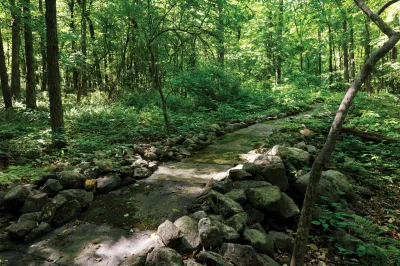
Negotiating with nature is a hallmark of the works the Krauses have commissioned. Michael Van Valkenburgh, the property’s landscape architect, introduced the Krauses to a student of his, Jon Piasecki, in Harvard’s Graduate School of Design. On Piasecki’s first visit to the property, he ran into a forested area and called out that he’d found the remnants of an old stone wall, assembled haphazardly back when farmers cleared the field. He told Peter that he wanted to build a path along the wall. Soon, using stones from nearby Connecticut, Piasecki began laying out the almost unnoticeable pathway—beginning atop the wall, continuing inside the wall, emerging atop the wall—in the Fibonacci sequence. Working with only a hammer and chisel, he spent three years, from April to November, on the project, finishing in 2009. “Everything here is placed here for a reason,” Jill said. “At one point, I was walking through while he was working, and I said, ‘Look, a snail.’ And he replied, ‘I know. I put it there.’”
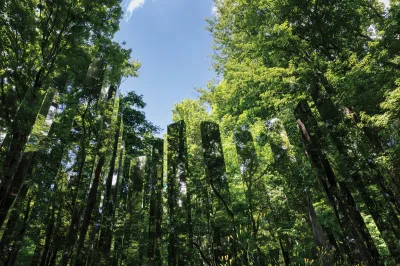
Further along in the woods is a Jose Dávila sculpture fabricated to look like cut-out sections of a blue shipping container—“a riff on if a Donald Judd stack had fallen over,” Jill joked. Beyond that is a labyrinth-like installation of mirrors by Jeppe Hein that reflects the forest back onto itself. In a nearby field is a series of sculptures by Katja Strunz that imagines the spreading of a mother dandelion’s seeds. A towering piece by Monika Sosnowska is, as Jill put it, “a staircase that has collapsed and has become a tree in the forest.”
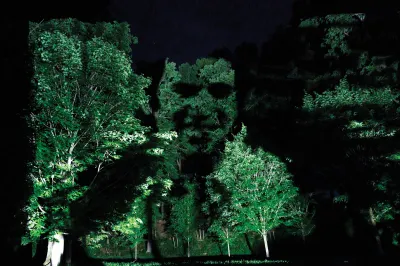
After dusk, Jill took me to see the three video installations. The late Ján Mančuška’s short film The Invisible Exists (2009) was his only animation work, an enigmatic story rendered in ballpoint pen. Tony Oursler’s installation, titled +/- (2023), sends three projections onto different tree lines and relays an idiosyncratic history of the Hudson River Valley, where the artist grew up, bringing in everything from technological advances like the telegraph and early filmmaking to references to West Point, IBM, and the cultish religion of the Oneida Community.
But the tour de force is Doug Aitken’s Lighthouse (2012). Aitken visited before the house was built. “It really struck me—the power of the landscape,” Aitken told me, recalling that he told the Krauses, “If you ever do build something here, I think we should make an artwork that makes it disappear, because this impression that we’re having today is so profound.”
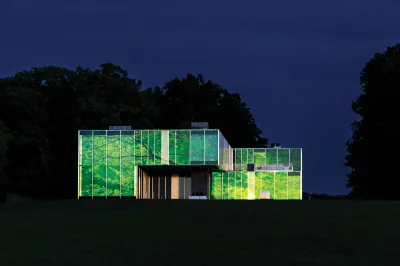
Aitken visited several times over the course of a year—in all four seasons and at all hours of the day—to capture video footage of the natural landscape. Lighthouse projects those images onto the house. “We found all these moments of the changing entropy of the landscape: the melting snow, the sun moving across the forest,” the artist said. In the resulting piece, “as day turns into night, the structure turns into this image of the landscape around it.”
“It was profound finding collaborators who were willing to take that journey,” Aitken said. “As far as collectors go, it’s so important to see things beyond the [object], and instead look to actually push where art can go, what it can be, and what forms it can transform into. They really believe in the true potential of art—the idea of art as an agent of change. They’re open to challenging works, provocative ideas, and works that are outside the box. We need more of that.”
Read More About:
- ARTnews Top 200 Collectors
- Doug Aitken
- Jill Kraus
- Peter Kraus
- Tatiana Trouvé
- Tony Oursler
- Top 200 2026