
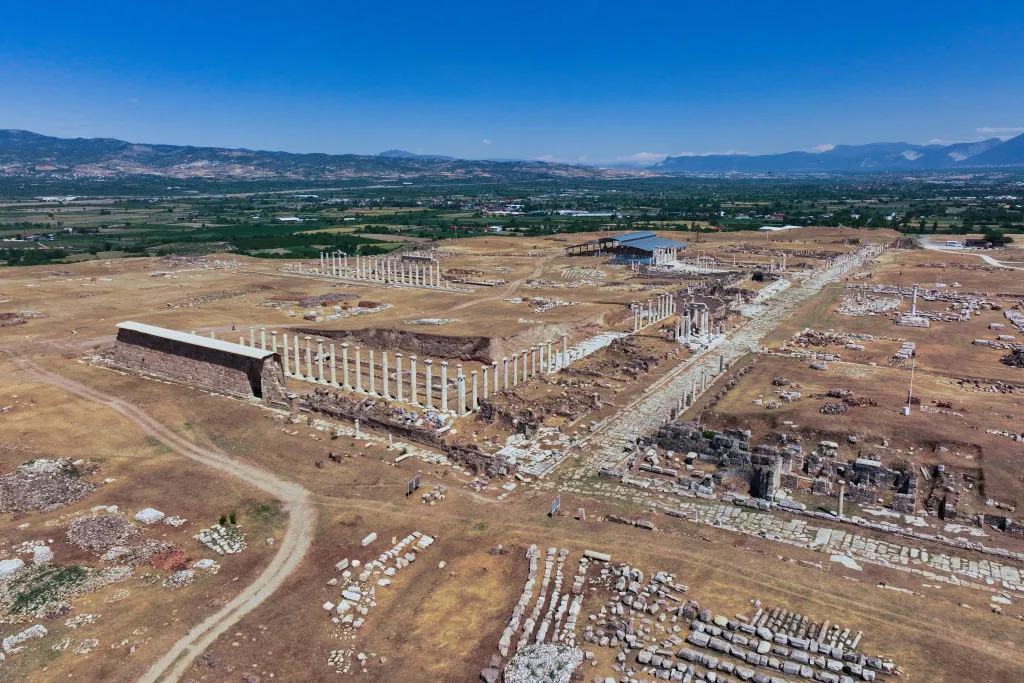
A well-preserved Roman council building has been identified by archaeologists in the ancient city Laodicea or present-day Denizli in southwestern Turkey, reported Anadolu Agency.
The building is thought to have been the administrative and judicial center of Laodicea, where elders, youths, and citizens alike governed the city. Dating back to the late first century BCE, the structure features a previously unknown design in Anatolia, with pentagonal outer walls and a hexagonal interior. The assembly hall is estimated to have hosted between 600 to 800 members at any given time.
Related Articles
Long Droughts May Have Played a Significant Role in the Decline of Ancient Mayan Civilization
England's Norwich Castle Reopens Following $37 M. Restoration
Seats engraved with names helped experts identify specific roles within the government structure. A seated statue, believed to be the city’s chief judge, boasted a head that had been swapped, perhaps indicating leadership changes.
The council building was used through the seventh century CE and was integrated with other key urban establishments typical of Ancient Roman cities, including a political agora, archive halls, a large bath complex, and the region’s biggest stadium.
Previous finds in Laodicea include intricately frescoed travertine blocks, a nearly ten-foot statue of Roman Emperor Trajan, the Trajan Fountain, a statue of a priest’s head, and a group sculptures of the monster from Homer’s The Odyssey the Scylla.
Excavations have been ongoing at the site since 2003. This discovery marks a major milestone, shedding light on the city’s once vibrant administrative and judicial hub.
Laodicea was founded by Seleucid King Antiochus II Theos in a rebellion about 2,300 years ago. It remained active until an earthquake in the 7th century CE left the city in ruins and, under the Anatolian Beyliks, it was used as a pasture. Located within fertile lands, Laodicea served as a major hub for textile production and trade, and is considered one of the most significant metropolises in Anatolia. The city is on UNESCO’s Tentative List of World Heritage Sites.
Read More About:
- archaeology
- Denizli
- Laodicea