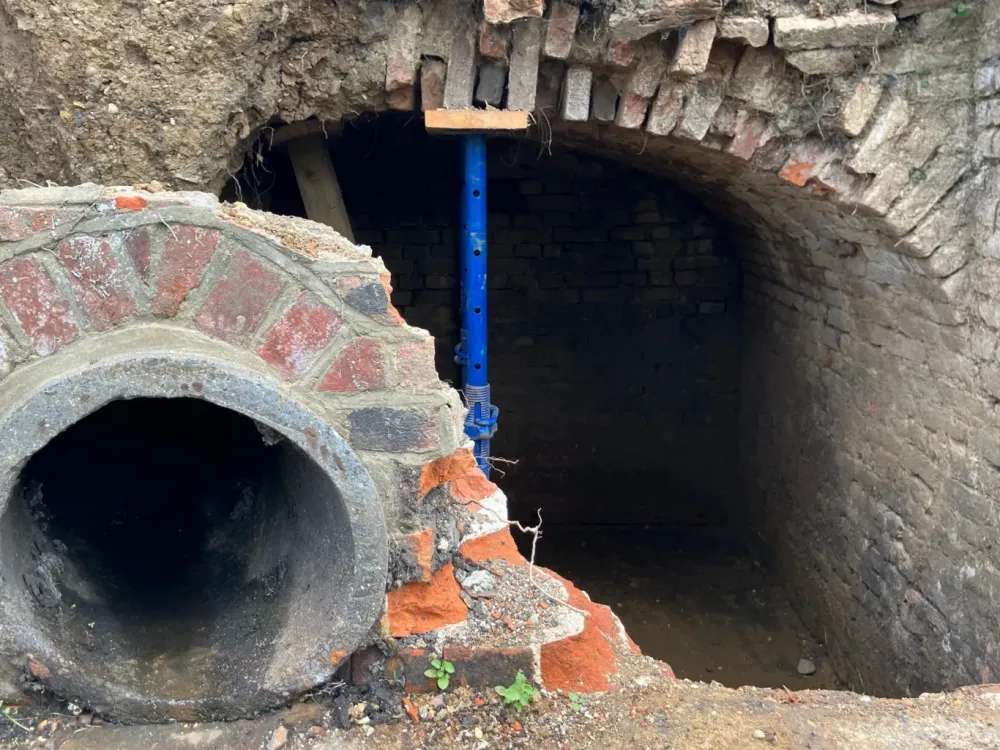
Tunnels dating to Henry VIII’s reign have been discovered on the grounds of New Hall School in Chelmsford, England. The news was first reported by the BBC earlier this month.
Workers repairing a ha-ha, a ditch traditionally used to contain livestock without interrupting the view across an estate, uncovered a tunnel entrance, along with Tudor-era artifacts including pottery, bones, and glass bottles.
New Hall School is named for New Hall, a house Henry VII acquired from his future (and ill-fated) wife Anne Boleyn’s family in 1517 and rebuilt as the much grander Palace of Beaulieu. A favorite royal residence in the 1520s, the house’s importance declined after Henry’s death, and it was removed from Crown possession during Elizabeth 1’s reign.
Related Articles

Two 1,700-Year-Old Roman Marble Statues Surface Inside an Ancient Wine Vat in Israel
Chinese Archaeologist Liu Bin, Known for Work at Liangzhu Site, Pleads Guilty to Corruption and Misappropriation Charges
In the 18th century, much of the palace was demolished save for the north wing, which was greatly altered. In 1798 it was purchased by nuns of the Order of the Holy Sepulcher, who opened New Hall School there in 1799. A Catholic school to this day, the school is now an independent boarding academy that proudly displays Henry VIII’s authentic coat of arms inside its chapel.
The find has generated considerable excitement among staff and students at the New Hall School. Sarah Garside, head of history at the school, described the institution to the BBC as a “really unique and exciting place to teach history.” Added Paul Goulding, the head of sixth form there, “To see history here in such a tangible way is a remarkable opportunity for both students and teachers.”
Researchers enlisted by the school have only excavated a small section of the tunnel system so far. It is believed that it may have been part of a network of service corridors and storage areas for Henry’s palace. Archeological investigations are expected to continue.
Read More About:
- archaeology
- King Henry VIII